At first, it feels like care.
This post may contain affiliate links.
That’s what makes it so easy to accept.
It sounds like concern.
It feels like protection.
Stay connected
New podcast episodes, articles, and reflections on healing, growth, and becoming.
It looks like someone paying close attention to you… your choices, your life, your well-being.
The Quiet Confusion
And then… something shifts.
Not enough to name right away.
Not enough to clearly explain.
Just enough to feel… off.
You might start to notice:
- a subtle pressure you can’t quite define
- a feeling that your choices are being influenced
- a sense that you’re adjusting more than you realized
But instead of immediately calling it what it is…
you pause.
You try to understand it.
You give it the benefit of the doubt.
Because you thought you would recognize it if something was wrong.
And in the beginning, that can feel comforting.
Because being cared for feels good.
The Subtle Shift
But sometimes… something shifts.
Not all at once.
Not in a way that’s easy to point to.
Just slowly.
The questions become more frequent.
The opinions become more persistent.
The “suggestions” start to feel less optional.
And you might not notice it right away.
Because nothing feels obviously wrong.
It just feels… different.
When Care Starts to Feel Like Pressure
There’s a difference between someone caring about you
and someone trying to manage you.
But that line can get blurry.
Especially when the words still sound kind.
The Disappointment Is Real
There’s a specific kind of disappointment that comes with this.
Not just because something wasn’t right—
but because you thought it would be different this time.
You thought you would see it.
Catch it.
Avoid it.
And when you don’t…
it can feel like you failed in some way.
But you didn’t.
“I just don’t think that’s a good idea.”
You Didn’t Fail—You Grew
The goal was never to become someone who can predict everything.
The goal was to become someone who can recognize what doesn’t feel right
and respond to it.
And that’s exactly what you’re doing.
Growth doesn’t always look like avoidance.
Sometimes it looks like:
- recognizing something sooner
- trusting yourself a little faster
- choosing differently, even when it’s hard
“I’m only saying this because I care about you.”
“I worry about what will happen if you do that.”
And again—maybe they do care.
But over time, you start to feel something underneath it.
Pressure.
A sense that your choices are being watched.
Evaluated.
Quietly redirected.
The Internal Experience
This is usually where it becomes confusing.
Because on the outside, it still looks like care.
But on the inside… it feels heavier.
You might notice:
- You hesitate before making decisions
- You mentally run things through how they’ll react
- You feel the need to explain or justify yourself
- You start doubting your own instincts
And you might not connect it to control.
You might just think you’re being considerate.
Or thoughtful.
Or trying to keep the relationship steady.
Why It’s So Easy to Miss
Control that starts as care doesn’t feel harsh.
It feels familiar.
It feels like someone being involved.
Like someone being invested.
Like someone loving you in a very attentive way.
And if you’ve never been shown what healthy space looks like…
this can feel normal.
Even right.
Until it doesn’t.
The Moment You Start to Notice
Awareness usually doesn’t come in a dramatic moment.
It’s quiet.
It’s a realization that you don’t feel as free as you used to.
That you’re adjusting more than you realized.
That your voice feels a little… smaller.
You might not have language for it yet.
But you feel it.
And that feeling matters.
Care vs Control
Care says:
“I trust you to make your own decisions.”
Control says:
“I need to influence your decisions so I feel okay.”
Care supports you.
Control manages you.
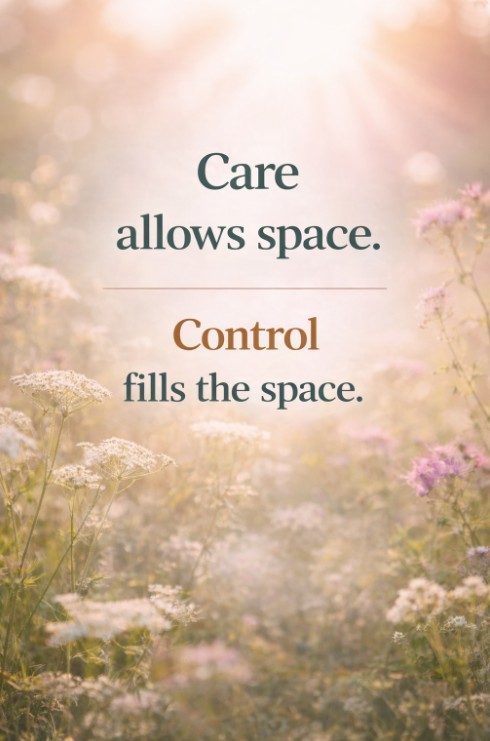
Care allows space.
Control fills the space.
And when you start to feel like you need permission to be yourself…
that’s worth paying attention to.
You’re Allowed to Notice the Difference
You don’t have to immediately label everything.
You don’t have to confront it all at once.
But you are allowed to notice how something feels.
To recognize when something that once felt comforting…
now feels restrictive.
To acknowledge when care has slowly started to feel like control.
You’re not wrong for accepting it when it felt like care.
You’re not naive for not seeing the shift right away.
It wasn’t obvious.
It was gradual.
Subtle.
Quietly changing over time.
And now…
You’re beginning to notice.
You’re not back where you started.
Even if it feels familiar.
You’re responding differently.
You’re seeing it more clearly.
You’re not staying the same way.
And that matters more than getting it “right” from the beginning.