There’s a question so many people quietly carry:
This post may contain affiliate links.
If this is hurting me… why is it so hard to let go?
Why do you still care?
Why do you still think about it?
Stay connected
New podcast episodes, articles, and reflections on healing, growth, and becoming.
Why does leaving sometimes feel harder than staying?
If you’ve ever wrestled with those questions, you’re not alone—and you’re not weak.
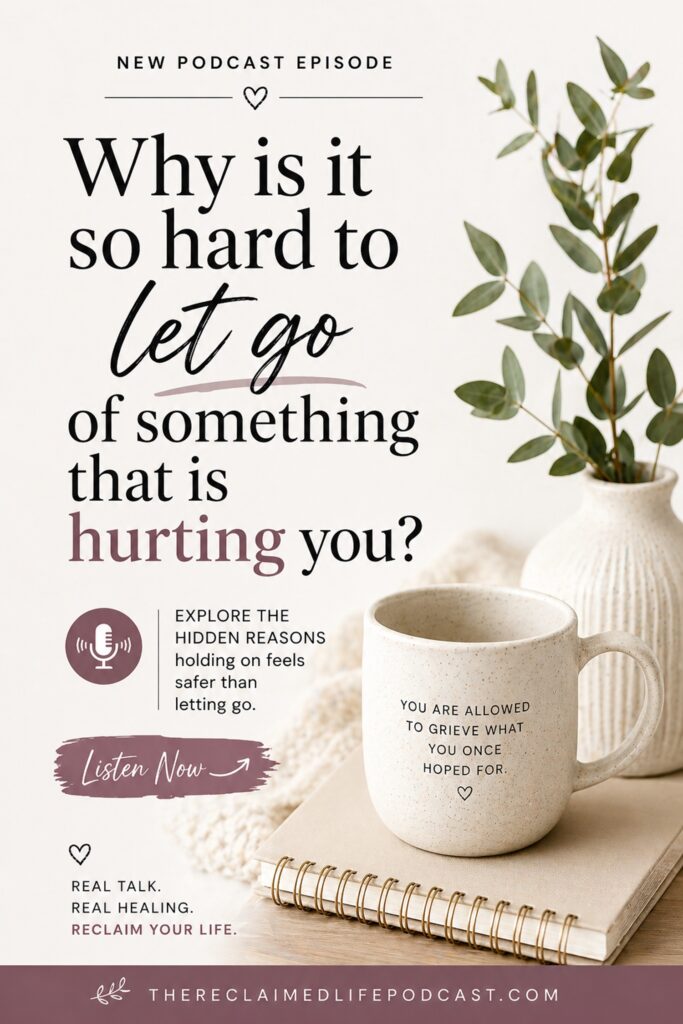
When Letting Go Isn’t Simple
We often tell ourselves that letting go should be straightforward.
If it hurts, walk away.
If it’s unhealthy, move on.
If it keeps disappointing you, let it go.
But real life doesn’t work that way.
Because we don’t just attach to what is good for us.
We attach to what is familiar…
What once felt meaningful…
What we hoped would change…
What we invested time, energy, and identity into.
So when something hurts, you’re not just walking away from pain.
You may be walking away from:
- The history you built
- The version of yourself you were in that space
- The hope that things could still become something safe
- The future you imagined
And that is not a small thing to release.
The Part No One Talks About
Painful situations are rarely painful all the time.
There were moments that felt good.
Moments that felt connected.
Moments that made you believe things could shift.
And that mixture—hurt and hope, distance and closeness—creates confusion.
It makes letting go feel like you’re losing something real… because you are.
Not just what was.
But what could have been.
You Might Be Grieving More Than You Realize
Sometimes what makes letting go so hard isn’t the situation itself.
It’s the grief underneath it.
You may be grieving:
- The apology that never came
- The change that never happened
- The version of the relationship you believed in
- The ending you didn’t get
You’re not just releasing reality.
You’re releasing the story you were still holding.
Why It Can Feel So Hard to Leave
There are deeper layers that make letting go complicated:
Sometimes your nervous system has adapted to the cycle.
Sometimes peace feels unfamiliar at first.
Sometimes hope feels easier to carry than grief.
Sometimes you were taught that staying equals love.
So you stay longer than you want to.
You try harder than you should have to.
You question yourself more than you deserve.
Not because you’re weak.
Because you’re human.
What Letting Go Actually Looks Like
Letting go is rarely one big, clean decision.
It’s usually a series of small ones:
- Seeing the pattern
- Telling yourself the truth
- Allowing the grief
- Choosing yourself again and again
- Sitting with discomfort without going back
It can feel slow.
It can feel messy.
It can come in waves.
That doesn’t mean you’re failing.
It means you’re untangling something real.
Listen to the Full Episode
In this episode of The Reclaimed Life Podcast, I go deeper into why letting go feels so difficult—and what’s really happening beneath the surface.
If you’re in the middle of trying to release something that’s hurting you, this conversation will help you make sense of what you’re feeling.
It may be hard to let go of something that is hurting you…
Because you’re not just releasing pain.
You’re releasing attachment, hope, meaning, and the version of the story you wanted.
That is a real loss.
Treat it like one.
And when you’re ready—
You won’t let go because you suddenly became stronger overnight.
You’ll let go because you finally gave yourself permission
to stop carrying what was hurting you.